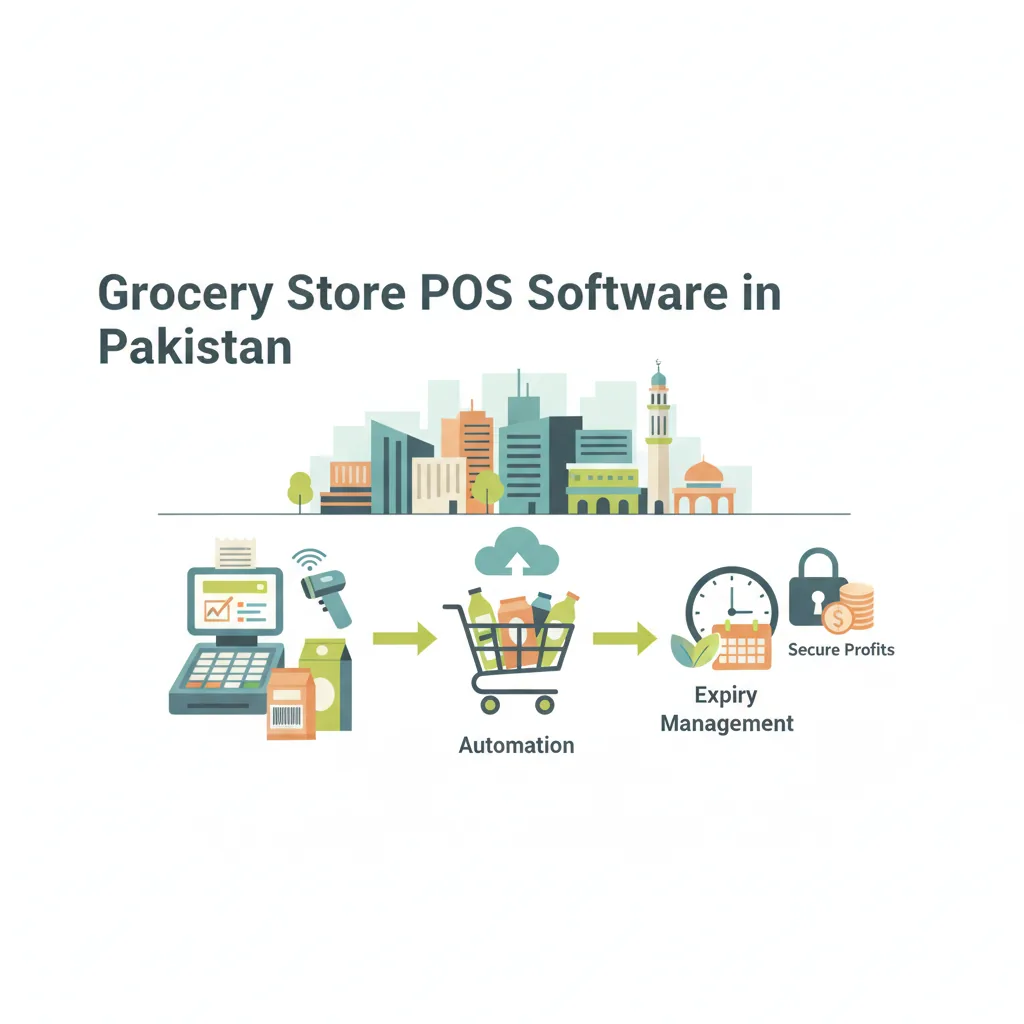
Grocery Store POS Software in Pakistan: Billing, Inventory and Expiry Management
A comprehensive guide for Pakistani grocers, mini-marts, and supermarkets on choosing POS software that speeds up checkout, automates barcode inventory, tracks perishable expiry dates, and secures daily profits.
In this article
- Fast Counter Billing and Barcode Scanning Under Peak Pressure
- 1. Universal Barcode Recognition
- 2. Split Payments and Transparent Discounts
- 3. Uninterrupted Offline Resilience
- Real-Time Inventory Control for Thousands of FMCG SKUs
- Mastering Product Expiry Dates and FIFO Stock Discipline
- Supplier Purchases, Credit Ledgers, and Procurement Workflows
- Daily Sales Reports and Financial Audits
- Grocery Store POS Software in Pakistan: The Evaluation Checklist
- How CloudPOS Helps Pakistani Grocery Stores and Marts
- Take Control of Your Grocery Counter and Margins
In this guide: how grocery store POS software in Pakistan speeds up billing, controls inventory and manages expiry dates.
Between 6:00 PM and 10:00 PM, grocery stores and mini-marts across Pakistan face their ultimate operational test. Trolleys line up at the counter, customers are impatient to get home, and cashiers juggle hundreds of FMCG items ranging from loose pulses to branded dairy, packaged spices, and cold beverages. In that rush, a five-second delay per item or a barcode that refuses to scan creates a frustrating bottleneck that spills into the aisles.
Behind the counter, the financial stakes are just as high. Retailing fast-moving consumer goods (FMCG) is fundamentally a volume business built on thin margins, often averaging between 8% and 15% on packaged goods. A shop owner cannot afford stockouts of high-velocity essentials like cooking oil or flour, nor can they afford to absorb cartons of expired yogurt, bread, or biscuits forgotten at the back of a storeroom shelf.
Operating a profitable retail grocery business today requires replacing manual registers and disjointed spreadsheets with dedicated retail technology. Investing in the right grocery store POS software in Pakistan: billing, inventory and expiry management has transformed from an administrative luxury into the operational backbone of modern general stores, marts, and supermarkets.
Fast Counter Billing and Barcode Scanning Under Peak Pressure
At the checkout till, speed and accuracy determine customer satisfaction. A modern grocery counter must handle high basket sizes—frequently 15 to 40 items per shopper—without slowing down or crashing under load.
1. Universal Barcode Recognition
Most packaged consumer goods in Pakistan carry standard international EAN-13 barcodes. A purpose-built grocery POS instantly identifies manufacturer barcodes via standard USB, Bluetooth, or omnidirectional laser scanners. For items without factory codes—such as repackaged dry fruits, bakery items, or store-packed lentils—the software must allow on-demand barcode label generation and quick lookup by item code or name.
2. Split Payments and Transparent Discounts
Consumers increasingly split payment methods, offering partial cash and digital payment, or applying promotional discounts on specific cart totals. A proper grocery billing interface applies item-level or total cart discounts transparently while calculating change instantly, eliminating manual mental arithmetic errors by cashiers.
3. Uninterrupted Offline Resilience
Unstable broadband connections and sudden power fluctuations remain common operational hurdles in Pakistani commercial markets. If a point-of-sale system relies strictly on a live internet connection, a sudden network drop freezes the queue entirely. Reliable grocery store POS software must offer an offline billing engine: cashiers continue scanning products, calculating totals, and printing thermal receipts uninterrupted, while the data syncs silently with cloud servers the moment the connection returns.
Real-Time Inventory Control for Thousands of FMCG SKUs
A typical neighborhood mart manages anywhere from 2,000 to over 10,000 active SKUs across personal care, pantry staples, dairy, beverages, and household cleaning. Tracking these items manually is impossible.
When stock tracking relies on visual checks, two costly problems occur:
- Invisible Stockouts: High-margin products run out during high-traffic weekends, driving loyal shoppers to competing stores.
- Tied-Up Working Capital: Capital gets frozen in slow-moving bulk items that sit on shelves for months, gathering dust while tying up cash needed for fast movers.
Modern retail systems maintain perpetual, real-time inventory counts. Every barcode scan at the register automatically deducts that unit from the system. When stock levels fall below a predetermined threshold, the software triggers smart low-stock alerts, allowing the purchasing manager to reorder before shelves go empty.
Mastering Product Expiry Dates and FIFO Stock Discipline
Perishable inventory is the quietest profit killer in grocery retail. In Pakistan's grocery sector, distributor return policies vary widely. While some international FMCG brands accept expired goods under strict return windows, many local suppliers enforce "no-return" policies on damaged or expired stock, leaving the store to write off the entire retail value.
Proper expiry management requires both operational protocol and software enforcement:
- Batch and Expiry Logging at Receiving: When stock arrives from distributors, receiving staff log batch numbers and expiry dates directly into the POS system.
- First In, First Out (FIFO) Shelf Discipline: Merchandisers must rotate physical stock so older batches sit in front of newer arrivals, ensuring shoppers pull the earliest manufactured dates first.
- Automated Near-Expiry Alerts: Instead of discovering expired stock when a customer brings it to the counter, the POS alerts management 30, 45, or 60 days before products expire. This grants store owners enough runway to launch promotional bundle deals, offer markdown discounts, or return goods to suppliers before the credit deadline passes.
"A single carton of premium imported cheese or infant milk formula written off due to expiry can erase the net profits earned from an entire afternoon of grocery billing."
Supplier Purchases, Credit Ledgers, and Procurement Workflows
Grocery retailers in Pakistan interact with dozens of commercial suppliers every week, from large multinational distributors to local wholesale mandi vendors. Managing these interactions on loose paper slips (parchis) frequently leads to unrecorded supplier payments, disputed credit balances, and billing discrepancies.
Robust grocery POS and retail ERP software streamlines the full procurement cycle:
- Purchase Order (PO) Generation: Create clean purchase orders directly from system-generated low-stock lists, eliminating duplicate orders.
- Good Received Notes (GRN): Match incoming delivery challans against original purchase orders to detect missing cartons or unapproved price hikes instantly.
- Supplier Payables Management: Maintain accurate accounts payable ledgers for every vendor, ensuring you know exactly what is owed, what credit terms remain active, and which suppliers offer timely delivery.
Daily Sales Reports and Financial Audits
At the end of a long 14-hour store shift, grocery owners need clarity on their true daily earnings. Without automated sales reporting, store owners face end-of-day cash drawer mismatches and blind spots regarding net margins.
Comprehensive grocery store POS software generates clear daily closing reports with a single click:
- Cash Drawer Audits: Compares opening cash floats, system-recorded cash sales, digital card receipts, and petty cash payouts against actual drawer counts to spot shortages instantly.
- Category and Brand Profitability: Identifies which product categories (such as snacks, dairy, or cleaning supplies) generate the highest gross profit margins versus those that simply turn cash flow.
- Cashier Accountability: Tracks sales performance, item void rates, and refund actions by individual employee profiles, curbing unauthorized discounts and till shrinkage.
Grocery Store POS Software in Pakistan: The Evaluation Checklist
Before purchasing or switching point-of-sale systems for your grocery store or mart, review this checklist during your software evaluation:
- [ ] Rapid Barcode Checkout: Does the register process multi-item carts with instant USB and Bluetooth scanner recognition?
- [ ] Offline Transaction Billing: Can the counter continue scanning and printing customer invoices when the internet disconnects?
- [ ] Expiry and Batch Tracking: Does the inventory module alert you weeks ahead of expiry dates to prevent inventory write-offs?
- [ ] Smart Low-Stock Alerts: Can you set custom minimum thresholds for essential grocery staples?
- [ ] Supplier Purchasing Ledger: Does the platform track purchase orders, vendor invoices, and outstanding accounts payable?
- [ ] Employee Role Permissions: Can you restrict access to cash drawer opening, discount overrides, and stock adjustments based on staff roles?
- [ ] Cloud Access and Mobile Oversight: Can the business owner monitor live sales numbers, counter shifts, and inventory levels remotely from a smartphone?
- [ ] Multi-Store Scalability: Can the software manage stock transfers and consolidated reporting across multiple branches if your business expands?
How CloudPOS Helps Pakistani Grocery Stores and Marts
CloudPOS delivers a cloud-based point-of-sale and AI-powered ERP platform engineered specifically to handle the high volume, high SKU counts, and rapid checkout demands of grocery retail in Pakistan.
With CloudPOS, grocers equip their businesses with tools designed for dependable daily performance:
- Fast Point of Sale: Accelerated barcode scanning, item-level discounts, refund management, and rapid thermal receipt printing that keeps evening queues moving swiftly.
- Offline and Online Hybrid Reliability: Cash counters continue processing sales and printing receipts during internet outages; the system automatically synchronizes transaction records with secure cloud servers as soon as connectivity resumes.
- Real-Time Inventory and Smart Alerts: Accurate stock tracking across thousands of packaged items with automated low-stock warnings, preventing painful stockouts on fast-moving household items.
- AI-Powered ERP and Procurement: Integrated supplier purchasing, finance ledgers, and accounts payable modules that streamline stock intake and vendor balance management.
- Employee Management and Security: Dedicated cashier access controls, shift tracking, and sales logs to ensure complete staff accountability at every counter.
- Mobile Reporting Apps: Business owners can check live sales turnover, profit summaries, and counter shifts from anywhere via dedicated iOS and Android mobile apps.
- Multi-Branch and eCommerce Integration: Manage one neighborhood store or coordinate inventory and price books across multiple mart branches from a single unified cloud account. For stores subject to formal invoicing standards, CloudPOS also features seamless FBR-integrated billing support.
Backed by dedicated support from its central offices in Gujrat, CloudPOS secures your data on high-availability cloud architecture with live replica servers and automatic backups, giving you complete peace of mind.
Take Control of Your Grocery Counter and Margins
In retail grocery, operational discipline separates growing, profitable marts from stores struggling with expired stock and lost cash. By connecting your cash till, warehouse stock, supplier invoices, and shelf rotation inside a reliable point-of-sale platform, you eliminate guesswork, protect your working capital, and deliver a smooth checkout experience that keeps neighborhood shoppers returning every week.
Ready to upgrade your grocery operations and eliminate inventory leaks? Contact the team at info@cloudpos.pk, call +92 309 308 9999, or book a free CloudPOS demo today to experience fast billing and intelligent stock management tailored for Pakistani retailers.
Related reading: POS software for garment stores · Salon POS software in Pakistan · CloudPOS grocery store POS
Further reading: GS1 barcode standards