AI in POS Software: How Pakistani Retailers Can Use Demand Forecasting and Smart Reordering
Discover how Pakistani retailers can turn daily checkout scans into accurate demand forecasts and automated reorder points. Learn how AI in POS software eliminates dead stock and prevents costly stockouts without expensive software licenses or in-house data teams.
In this article
- Can AI in POS Software Really Help an Independent Retailer or Small Shop?
- How POS Sales Data Unlocks Accurate Demand Forecasting
- 1. Sales Velocity and Rate of Sale
- 2. Seasonal Surges and Calendar Shifts
- 3. Day-of-Week and Payday Fluctuations
- 4. Supplier Lead Time Realities
- From Guesswork to Smart Reordering: How It Eliminates Dead Stock
- Checklist: Setting Up Smart Inventory Workflows in Your Store
- How CloudPOS Helps Pakistani Retailers Automate Reordering
- Make Your POS Work as Hard as Your Best Inventory Manager
If you run a retail shop, pharmacy, mart, or wholesale counter in Pakistan, you know the quiet anxiety that comes with ordering inventory, which is where AI in POS software starts to help. Order too little of a trending product, and frustrated customers walk across the street to your competitor. Order too much to secure a supplier discount, and you end up with cartons of slow-moving goods gathering dust in your godown while your working capital vanishes.
For decades, shopkeepers in markets from Shah Alam in Lahore to Bolton Market in Karachi have relied on gut feeling, scratchpad tallies, or rigid spreadsheets to decide what to restock. But consumer buying cycles move fast, and inflation leaves zero room for wasted cash. According to supply chain analysis published in the Fashion Retail & Supply Chain Technologies research, manual inventory tracking and traditional procurement practices continue to trigger widespread stock imbalances across Pakistani retail sectors.
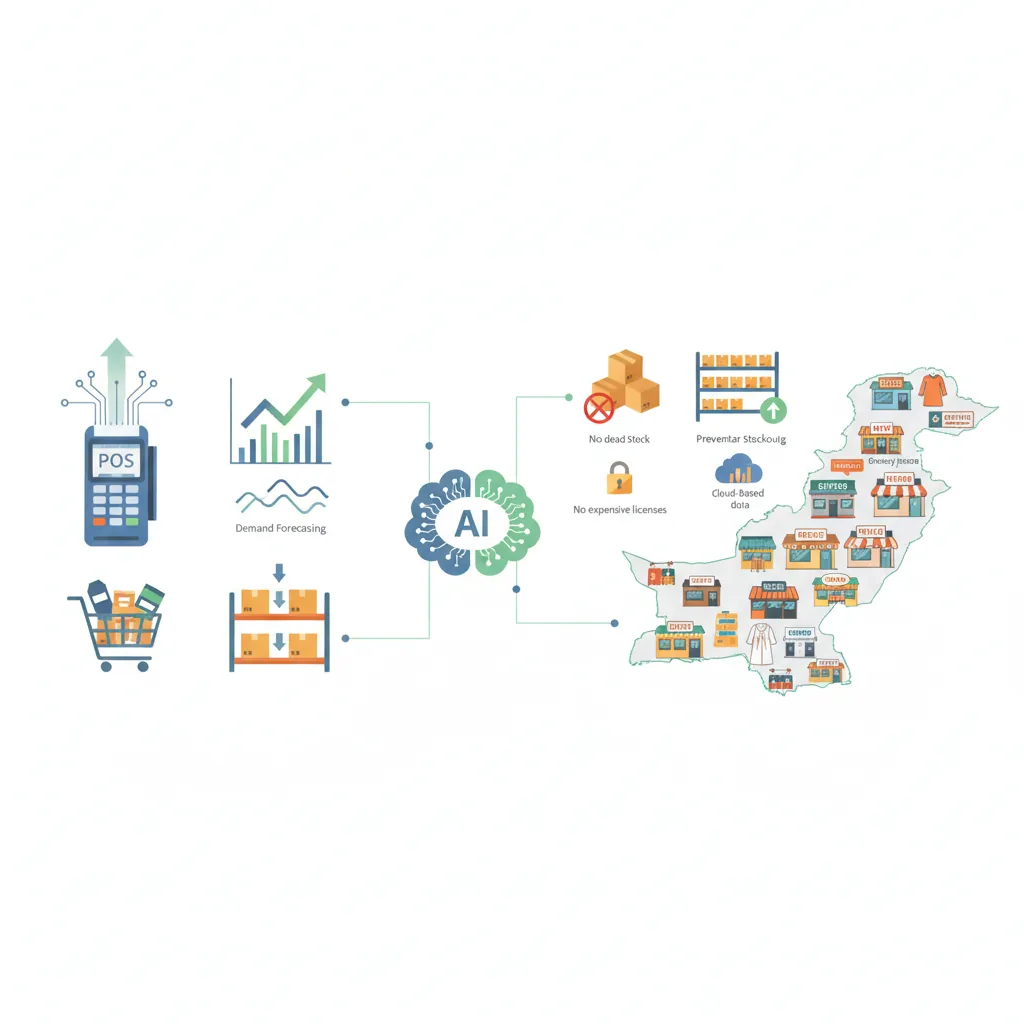
This is where AI in POS software: how Pakistani retailers can use demand forecasting and smart reordering becomes a practical game changer. You do not need a multinational budget or a team of data scientists to harness artificial intelligence. Today, modern point-of-sale systems turn the billing data you already collect every day into actionable reorder schedules that protect your profit margins.
Can AI in POS Software Really Help an Independent Retailer or Small Shop?
When most business owners hear "Artificial Intelligence," they picture robotics or expensive enterprise software built for global corporations. In modern retail technology, AI simply means practical pattern recognition.
Every time your cashier scans an item at checkout, your point of sale records critical operational breadcrumbs: the exact SKU, quantity, time of day, customer profile, and sales velocity. A traditional cash register stores this as flat history. AI in POS software, however, analyzes those historical patterns alongside current stock levels and supplier lead times to answer two vital questions:
- How many units of this item will my customers actually buy over the next 14 to 30 days?
- When is the exact date I must place a purchase order so I never run out of stock?
By automating this mathematical legwork directly inside your point-of-sale platform, even single-branch store owners can make procurement decisions with the precision of major hypermarkets—without hiring business intelligence consultants or spending hours building manual formulas.
How POS Sales Data Unlocks Accurate Demand Forecasting
Demand forecasting in modern retail is not crystal-ball guessing; it is the systematic processing of real sales signals. Global retail studies by Teamcore and Zebra Technologies highlight that unexpected stockouts cause over 70% of shoppers to experience friction or leave stores without completing their purchases. Predictive algorithms integrated into retail point of sale eliminate this friction by evaluating four core factors:
1. Sales Velocity and Rate of Sale
Different SKUs move at radically different tempos. A 1-liter cooking oil brand might sell 40 units a day, while a premium imported olive oil sells 3 units a week. Predictive algorithms track moving averages rather than static historical totals, adjusting expectations if a product suddenly gains traction or begins to slow down.
2. Seasonal Surges and Calendar Shifts
Pakistani retail has dramatic seasonal rhythms: the pre-Ramadan grocery rush, the surge in unstitched fabrics before Eid-ul-Fitr, wedding season demand for cosmetics and confectioneries in the winter months, and summer spikes for beverages. An intelligent POS system compares year-over-year sales cycles, alerting you weeks ahead of peak demand so you can arrange distributor bookings before local market shortages hit.
3. Day-of-Week and Payday Fluctuations
Most retail outlets experience noticeable sales spikes during the first five days of the month (when salaries are disbursed) and on weekends. Intelligent POS algorithms evaluate these micro-trends so your Friday replenishment orders reflect weekend volume rather than mid-week averages.
4. Supplier Lead Time Realities
If your FMCG distributor delivers every Tuesday, your reorder threshold is very different from an electronics vendor delivering goods from a central godown with a 10-day dispatch turnaround. POS systems with smart reordering integrate supplier turnaround times directly into procurement recommendations.
From Guesswork to Smart Reordering: How It Eliminates Dead Stock
Dead stock is the silent profit killer in Pakistani retail. When rupees sit frozen in unsold garments, obsolete mobile accessories, or expired pharmaceutical packages, your cash flow suffocates. A report on inventory management by Inbound Logistics notes that carrying unmonitored dead inventory ties up vital operational capital while driving up storage and handling costs.
Smart reordering replaces static "minimum stock" settings with dynamic thresholds:
- Automated Reorder Point (ROP) Calculation: The POS continuously recalculates your safety stock using actual sales velocity multiplied by vendor lead time. You no longer wait until a shelf is empty to reorder.
- Suggested Purchase Quantities (EOQ): Instead of a distributor sales rep convincing you to buy 20 cartons of slow-moving stock for an extra 2% trade discount, your POS recommends the exact quantity needed to bridge sales until the next delivery window.
- Slow-Mover and Expiry Warning Triggers: Before products reach critical non-movement thresholds (such as zero scans over 45 days), the system flags them for clearance, bundling, or supplier returns before they turn into complete write-offs.
"True profitability in retail is not just about what you sell over the counter today—it is about keeping every rupee of working capital actively circulating instead of trapped in dusty godown boxes."
Checklist: Setting Up Smart Inventory Workflows in Your Store
You can begin implementing intelligent stock management right away. Save this practical operational checklist for your store manager or inventory lead:
- [ ] Audit and Standardize Barcodes: Ensure every product variant (size, shade, flavor) has a unique barcode scan code to prevent combined sales velocity errors.
- [ ] Record Accurate Supplier Lead Times: Note down realistic dispatch-to-shelf delivery days for every primary supplier in your system.
- [ ] Categorize Your Fast-Movers (ABC Analysis): Focus forecasting efforts first on your top 20% of revenue-generating SKUs (Class A items).
- [ ] Log Supplier Dispatches Directly into POS: Never accept stock onto shelves without generating a receiving slip in your software to maintain perfect stock accuracy.
- [ ] Review Weekly AI Stock Exception Reports: Dedicate 20 minutes every Monday morning to review suggested purchase orders and slow-moving inventory alerts.
How CloudPOS Helps Pakistani Retailers Automate Reordering
Deploying predictive inventory management does not require buying separate forecasting tools. CloudPOS (cloudpos.pk) integrates advanced retail intelligence directly into an easy-to-use cloud POS and AI-powered ERP platform designed specifically for the Pakistani retail landscape.
Here is how CloudPOS streamlines demand planning and stock control for retail shops, pharmacies, apparel stores, and wholesale businesses:
- Real-Time Inventory Management with Smart Low-Stock Alerts: CloudPOS monitors your stock across all active SKUs in real time, alerting counter staff and purchasing managers the moment items approach reorder thresholds.
- AI-Powered ERP Procurement: Connect daily point-of-sale data directly to back-office procurement and finance modules. The system generates automated suggested purchase orders based on recent sales trends, avoiding over-ordering.
- Multi-Store Inventory Balancing: Managing multiple branches or a central godown? CloudPOS lets you track stock movement across all locations from a single dashboard. If Branch A is running low on an item that is sitting idle in Branch B, you can initiate a stock transfer before issuing an unnecessary supplier order.
- Reliable Online and Offline Billing: Internet outages and power cuts should never stop your counter. CloudPOS continues billing seamlessly offline; once your internet reconnects, all transactions sync automatically to update your cloud inventory levels.
- Dedicated Mobile Business Apps: Track fast-moving items, daily gross margins, and stock alerts directly from your smartphone, whether you are on the retail floor or negotiating at wholesale markets.
CloudPOS also integrates seamlessly with digital invoicing standards, local payment channels, and eCommerce platforms, giving expanding retailers complete control over their operations.
Make Your POS Work as Hard as Your Best Inventory Manager
Every retailer knows that managing inventory on memory or static registers leads to missed sales and expensive dead stock. With modern retail systems, you no longer have to guess what your customers will buy tomorrow. By letting data-driven algorithms calculate your reorder cycles, you protect your hard-earned cash and maintain stocked shelves that keep customers coming back.
Ready to eliminate stockouts and stop tying up your working capital in unsold inventory? Visit CloudPOS to book a free CloudPOS demo today, and see how intelligent inventory management can transform your retail business.