Raast P2M QR Payments in Pakistan: What Every Retailer Needs to Know in 2026
With State Bank of Pakistan data showing digital channels processing over 90% of retail transactions, Raast Person-to-Merchant (P2M) QR payments are transforming store checkouts across the country. Discover why merchants are moving away from traditional card swipe machines, how to avoid counterfeit screenshot scams, and how to build a unified digital checkout system.
In this article
- The Data Behind the Shift: How Fast Is Digital Retail Growing?
- Why Pakistani Shop Owners Are Adopting Raast P2M QR Over Card Machines
- The Hidden Operational Risks of Ad-Hoc QR Billing
- 1. Counterfeit Screenshots and "Flash Screens"
- 2. The "Owner's Personal Phone" Bottleneck
- 3. Daily Reconciliation Chaos
- Checklist: Setting Up a Secure, Frictionless QR Checkout
- How Modern Store Management Software Connects the Pieces
- The Bottom Line for Pakistani Retailers
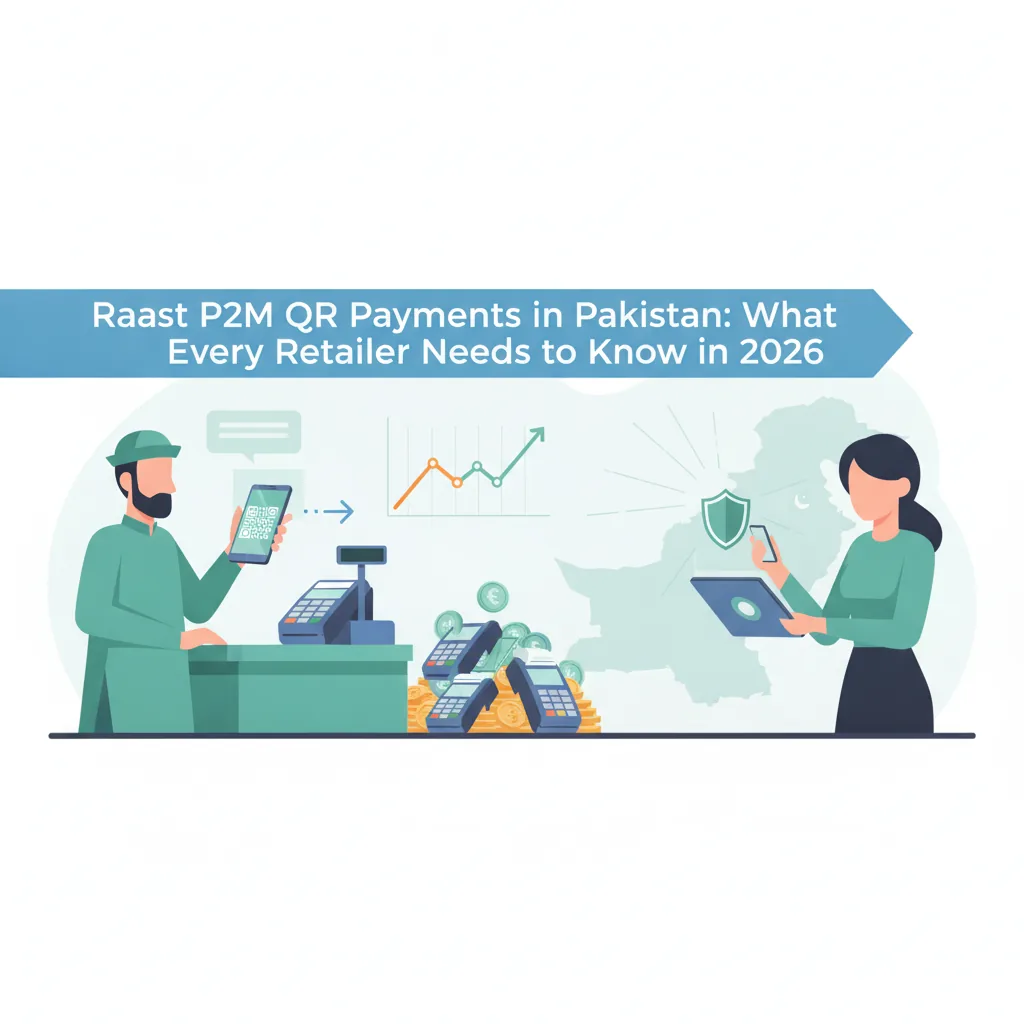
Step up to the counter of a boutique in Lahore, an electronics outlet in Karachi, or a busy neighborhood pharmacy in Rawalpindi, and you will notice a distinct change in how transactions happen. The familiar rustle of counting out PKR 5,000 notes or asking the shop assistant "Card machine chal rahi hai?" is rapidly giving way to a simpler action: the customer takes out their smartphone, scans an interoperable Raast P2M QR code on the counter, and completes the payment in five seconds.
This shift is not an accident. Over the past twelve months, the nationwide rollout of Raast Person-to-Merchant (P2M) payments, driven by the State Bank of Pakistan (SBP), has accelerated a quiet revolution on retail shop floors. For brick-and-mortar merchants, the implications go far beyond offering a trendy payment option; it fundamentally alters store cash flow, peak-hour queue speeds, and back-office reconciliation.
If you run a retail shop, pharmacy, restaurant, or multi-branch showroom in Pakistan, understanding how Raast P2M is reshaping consumer expectations is essential to keeping your store competitive and your cash registers accurate.
The Data Behind the Shift: How Fast Is Digital Retail Growing?
For years, Pakistan was described almost exclusively as a "cash-is-king" retail market. While cash still plays a significant role in informal trades, formal retail has passed an undeniable tipping point.
According to the State Bank of Pakistan's Annual Payment Systems Review, retail transactions processed through formal banking and payment channels surged to 14.3 billion transactions valued at PKR 673 trillion. Strikingly, digital channels accounted for approximately 92 percent of all retail payment volume, with mobile app transactions growing by nearly 79 percent year-on-year.
At the center of this transition is Raast P2M. While Raast was initially known for Person-to-Person (P2P) transfers between bank accounts, the widespread introduction of standardized merchant QR codes has pushed daily P2M transactions past the one-million mark. With commercial banks, microfinance providers, and Electronic Money Institutions (EMIs) like Easypaisa, JazzCash, SadaPay, and NayaPay connecting directly to the Raast infrastructure, more than one million merchants across Pakistan now display digital payment codes on their counters.
Why Pakistani Shop Owners Are Adopting Raast P2M QR Over Card Machines
Historically, independent shopkeepers in Pakistan resisted non-cash payments for understandable business reasons. Traditional card point-of-sale (POS) swipe terminals carried heavy friction:
- Steep Merchant Discount Rates (MDR): Banks routinely charged retailers between 1.5% and 2.5% on every debit or credit card swipe, directly eroding profit margins on fast-moving consumer goods and electronics.
- Monthly Terminal Rental Fees: Maintaining a physical card terminal often cost PKR 2,000 to PKR 5,000 per month in service fees, regardless of how often it was used.
- Delayed Settlements: Card revenues frequently took 24 to 72 bank hours to clear, tying up daily working capital needed for supplier payments.
- Hardware and Network Failures: Fragile thermal printers, faulty magnetic readers, and dropped cellular signals on standalone POS terminals routinely caused awkward bottlenecks during peak rush hours.
Raast P2M solves these specific friction points. Because the system relies on an open, interoperable national QR framework, a single printed or dynamic QR code at your checkout desk allows customers to pay from practically any Pakistani bank account or digital wallet. Transactions settle directly into the merchant's business account within seconds, drastically cutting merchant fees and eliminating expensive hardware rentals.
The Hidden Operational Risks of Ad-Hoc QR Billing
While the growth of Raast P2M offers obvious advantages, accepting digital payments without an organized store workflow creates serious operational vulnerabilities. Many Pakistani retail store owners make the mistake of simply taping a printed bank account QR code to their glass counter and trusting the cashier to verify payments manually. This practice introduces three major headaches:
1. Counterfeit Screenshots and "Flash Screens"
One of the fastest-growing checkout scams targeting busy clothing stores, supermarkets, and cafes involves fraudulent payment confirmation screens. A dishonest customer creates a forged transfer receipt or opens an app mockup that mimics a successful bank transfer screen, flashes it to a hurried cashier for two seconds, and walks out with the merchandise. If your cashier does not independently verify that the funds entered the store account, you absorb the loss.
2. The "Owner's Personal Phone" Bottleneck
In countless Pakistani shops, the business bank account or merchant wallet is registered to the owner's personal mobile number. When a customer scans the QR code at 8:30 PM, the cashier must call the owner—who may be away from the premises—to ask, "Bhai jaan, 4,200 rupees ka SMS aya hai?" This paralyzes the checkout line, frustrates waiting customers, and forces cashiers to guess when the owner is unavailable.
3. Daily Reconciliation Chaos
At the end of an eleven-hour business shift, the store manager must balance cash in the drawer, multiple credit card terminal batches, and dozens of separate QR notifications across different accounts. If your digital receipts are not logged in your store billing records against specific itemized invoices, discovering which transaction caused a discrepancy becomes an accounting nightmare.
Checklist: Setting Up a Secure, Frictionless QR Checkout
To capture the speed and convenience of Raast P2M without leaving your store vulnerable to fraud, adopt this practical five-point operational framework:
- Deploy an Official Merchant Account: Do not rely on a personal bank account or personal wallet for daily customer payments. Register as an authorized merchant through your bank or acquirer so your business benefits from dedicated merchant notification channels, higher transaction limits, and proper corporate audit trails.
- Decouple Notifications from Personal Phones: Ensure payment alerts arrive on a dedicated store-floor device, an automated merchant notification portal, or a dedicated branch notification system rather than the business owner's private phone.
- Enforce a Strict Invoice-First Policy: Cashiers should always scan items through the billing software first to generate the final total before initiating the QR payment. The customer must never transfer a rounded or arbitrary amount unattached to an invoice number.
- Train Staff on Visual Verification: Instruct cashiers to check the Reference ID or Transaction ID on the incoming confirmation and match it against the timestamp of the sale rather than merely glancing at the customer's phone screen.
- Conduct Unified End-of-Day Closings: Ensure your daily cash-up process categorizes sales into distinct payment modes—Cash, Card, and Raast/QR—so bank statements match your store software balance sheet down to the last rupee.
Retail Rule of Thumb: Never treat digital payments as an afterthought sitting beside your cash drawer. If a payment method is not recorded on your register at the moment of sale, your inventory counts and daily revenue figures will drift out of balance.
How Modern Store Management Software Connects the Pieces
Adapting to the rise of QR commerce requires a retail management backbone that bridges customer checkout, stock levels, and daily accounting.
This is where CloudPOS (cloudpos.pk) delivers structured control for Pakistani retailers. As a cloud-based retail POS and AI-powered ERP platform engineered specifically for local business environments, CloudPOS brings your payment methods and store operations into one coherent system:
- Fast, Structured Billing: CloudPOS processes transactions rapidly with full barcode scanning, item-level discounts, refunds, and digital invoicing. Cashiers can cleanly record split payments—such as partial cash and partial Raast QR transfer—on the same receipt.
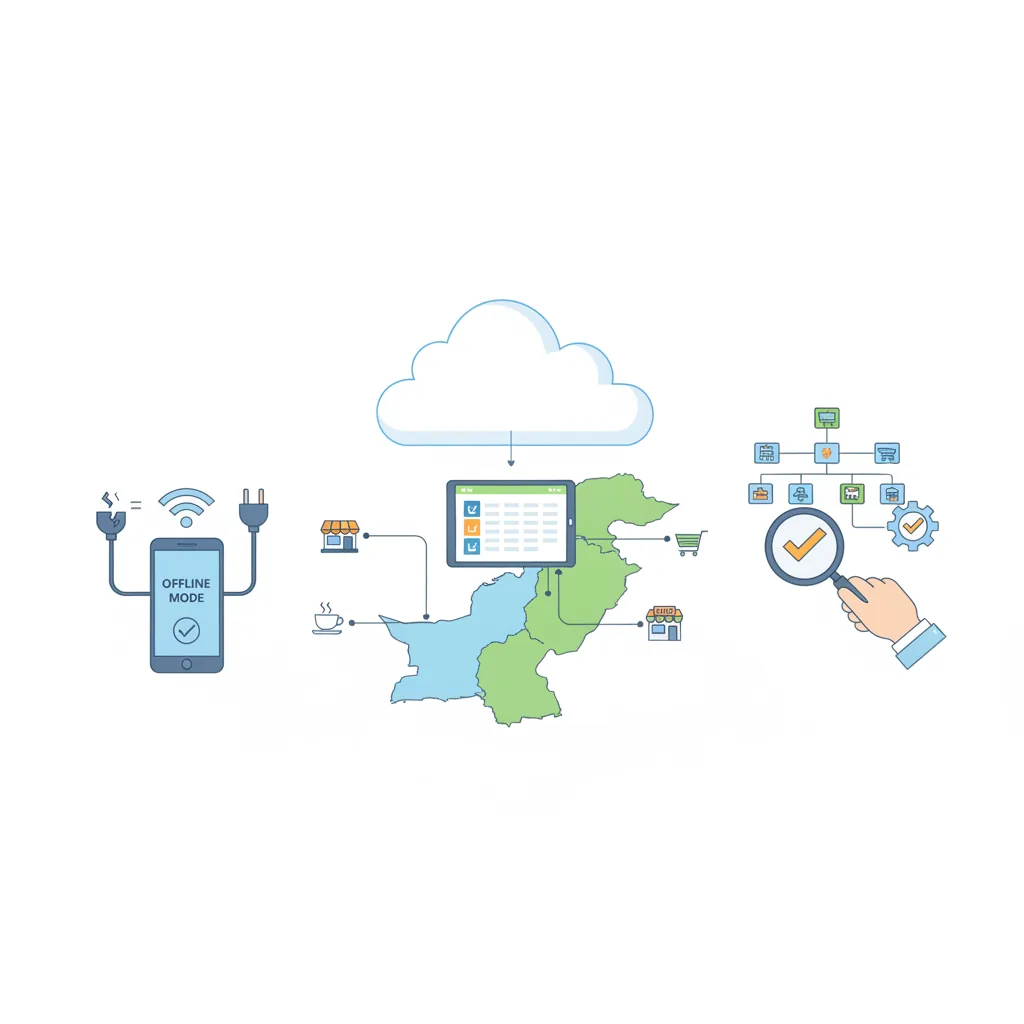
- Reliable Offline Billing: Internet disruptions at the market level will not halt your sales counter. CloudPOS continues billing seamlessly offline and automatically synchronizes all transaction records to the cloud the moment the connection is restored.
- Real-Time Inventory Control & Low-Stock Alerts: Every time a digital or cash sale completes, inventory quantities update immediately. Smart low-stock alerts notify your purchasing team before top-selling items run out.
- Staff Accountability & Access Controls: Protect your bottom line with role-based permissions. Restrict unauthorized price overrides, monitor staff sales performance, and keep shift handovers accurate with automated register closing reports.
- Multi-Store Oversight from Anywhere: If you operate two branches or ten, CloudPOS centralizes your sales, procurement, and stock transfers inside a single account, complemented by dedicated mobile apps to monitor daily store performance from your phone.
- Integrated Digital Invoicing: CloudPOS supports domestic regulatory standards, local tax requirements, and integrated digital billing without disrupting front-counter speed.
The Bottom Line for Pakistani Retailers
The explosive adoption of Raast P2M and QR payments marks a permanent evolution in Pakistani shopping habits. Customers have experienced the ease of paying straight from their phones, and they increasingly prefer businesses that accommodate fast, touch-free checkout without charging them extra or making them wait.
Shop owners who embrace this shift—pairing instant digital payment options with modern point-of-sale software—will enjoy faster counter turnover, fewer cash leaks, and accurate sales records. Those who cling to manual paper ledgers or disorganized personal transfer requests risk longer checkout lines and costly administrative errors.
Ready to upgrade your store's counter operations and eliminate checkout bottlenecks? Contact the CloudPOS team today at +92 309 308 9999, write to info@cloudpos.pk, or book a free CloudPOS demo to see how unified retail billing can grow your business.