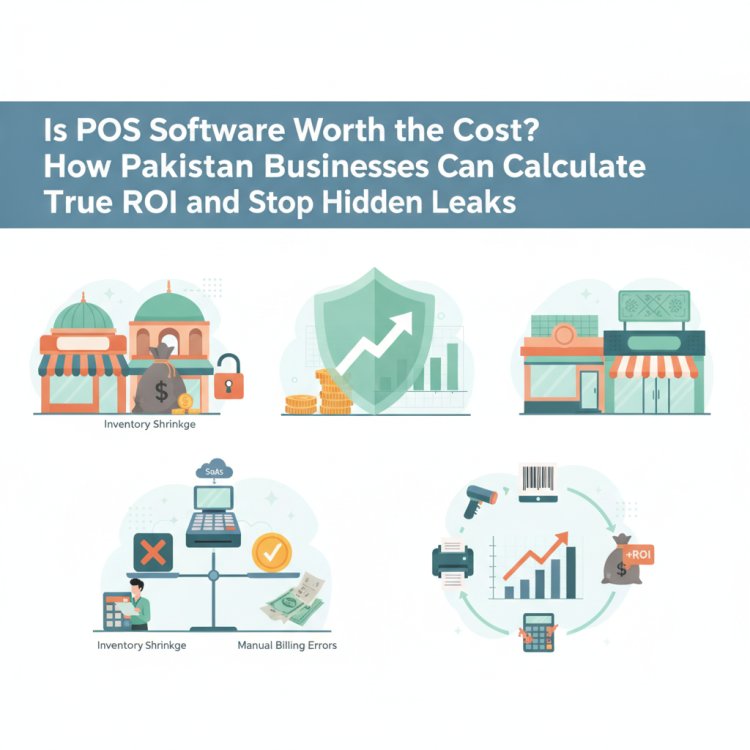
Is POS Software Worth the Cost? How Pakistani Businesses Can Calculate True ROI and Stop Hidden Leaks
Wondering whether POS software is a justified expense or an unnecessary overhead? This guide breaks down hidden inventory shrinkage, manual billing errors, subscription versus one-time costs, and how Pakistani retailers can calculate real ROI.
In this article
- The Invisible Leaks: What Operating Manually Truly Costs Your Business
- 1. Inventory Shrinkage and Administrative Stock Loss
- 2. Cash Counter Calculation Errors and Mispriced Sales
- 3. Capital Trapped in Dead Stock
- 4. Managerial Hours Spent on Manual Reconciliation
- Subscription vs. One-Time "Lifetime" License: The Cost Illusion
- What to Actually Budget for a POS Setup in Pakistan
- How to Calculate Your POS Return on Investment (ROI)
- Saveable Checklist: The POS Value Audit for Pakistani Retailers
- How CloudPOS Delivers Tangible Business Value
- Making an Informed Investment in Your Business Future
When you sit down at the end of a long retail day in Lahore, Karachi, or Gujrat, reviewing your shop's expenses can be an uncomfortable exercise. Rent is fixed, electricity bills under commercial tariffs remain high, staff wages are non-negotiable, and supplier invoices must be settled. In this climate, evaluating a point of sale (POS) system can easily feel like just another overhead expense you would rather postpone. After all, a paper ledger, a basic desktop spreadsheet, or an old electronic cash register technically records transactions without demanding a recurring software commitment.
However, treating modern business technology purely as an expense line on your income statement overlooks a critical financial reality: the real alternative to a modern POS system is rarely zero cost. The alternative is almost always an invisible collection of manual errors, stock shrinkage, untracked cash leakage, and tied-up working capital. To make a rational business decision, store owners must look beyond the initial purchase price and measure the true return on investment (ROI) that proper business software delivers.
The Invisible Leaks: What Operating Manually Truly Costs Your Business
Every business owner understands direct expenses because they arrive as printed bills. But the cost of operating without a unified sales and inventory system consists of silent micro-losses that slowly erode your gross margins throughout the trading month.
1. Inventory Shrinkage and Administrative Stock Loss
According to retail loss benchmarks published by the National Retail Federation (NRF), inventory shrinkage routinely accounts for over 1.5% of total retail sales, with internal administrative errors and unrecorded discrepancies representing more than 20% of that loss. In high-volume Pakistani retail environments—such as busy grocery marts, garment boutiques, cosmetics shops, and pharmacies—untracked stock loss is often much higher.
When items arrive from distributors and are keyed in manually or received without strict digital verification, discrepancies go unnoticed. A carton of 48 items recorded as 50, shelf damage that never gets written off, or unmonitored employee theft of fast-moving consumer items quickly totals tens of thousands of rupees each month. A business generating PKR 2,000,000 in monthly turnover losing just 2% to shrinkage is surrendering PKR 40,000 in pure margin every month—far more than the cost of maintaining robust store software.
2. Cash Counter Calculation Errors and Mispriced Sales
During peak shopping hours—such as weekend evenings or pre-Eid rushes—cashiers relying on memory, manual barcode lookups, or manual calculator additions inevitably make mistakes. A misread price tag, an incorrect discount applied at checkout, or miscalculated cash change may only cost PKR 50 to PKR 150 on an individual sale. Multiply that across dozens of hurried transactions per day, and the cash drawer mismatch turns into a substantial monthly deficit that directly reduces net profit.
3. Capital Trapped in Dead Stock
Cash flow in Pakistani retail depends on inventory turnover. Without automated reporting, business owners tend to reorder products based on visual checks or intuition rather than hard sales velocity data. This leads to over-purchasing slow-moving items that occupy valuable shelf space for months, while high-demand items stock out during peak trading hours. Dead stock ties up liquid working capital, exposes goods to expiration or dust damage, and forces painful clearance markdowns later on.
4. Managerial Hours Spent on Manual Reconciliation
Consider the time business owners and managers spend manually balancing cash registers, updating vendor books, tracking supplier balances, and recounting stock after closing. If manual administrative bookkeeping consumes two hours every evening, that represents 60 hours per month. For a business owner, those 60 hours should be spent negotiating supplier terms, opening new channels, evaluating branch locations, or serving high-value customers.
Subscription vs. One-Time "Lifetime" License: The Cost Illusion
When searching for billing software in Pakistan, retailers frequently encounter local vendors offering "one-time license" or "lifetime" offline software packages for a single upfront fee. At first glance, paying once seems significantly cheaper than an ongoing subscription. However, this comparison often conceals substantial long-term risks and hidden expenses.
- Hardware Dependency and Crash Risk: One-time systems typically live on a single local hard drive. If the hard disk fails, the operating system corrupts, or the shop computer suffers power surges, your entire sales history, vendor balance sheet, and inventory catalog can vanish overnight. Rebuilding that data manually can paralyze retail operations for days.
- Paid Updates and Maintenance Visits: "Lifetime" licenses rarely include software upgrades, bug fixes, or compatibility with changing digital invoicing regulations. When you need a re-installation, a technician call-out, or system adjustments, vendors routinely charge substantial unexpected service fees.
- Remote Visibility: Traditional single-computer software confines all business data to the physical counter. If you are away from the store, meeting suppliers in wholesale markets, or managing multiple outlets, you have zero visibility into daily revenue without calling the cash desk.
In contrast, a modern cloud-based subscription operates as an operational expense (OpEx). It ensures automatic data backups, ongoing security upgrades, compatibility with evolving tax systems and digital invoicing standards, and remote access across multiple devices without requiring dedicated in-house IT maintenance.
What to Actually Budget for a POS Setup in Pakistan
To evaluate software value objectively, you must understand what a complete, professional point of sale setup requires. A realistic budget contains three distinct layers:
- Counter Hardware: This includes durable hardware tailored to your trade: a standard PC, laptop, or tablet; a reliable 80mm thermal receipt printer; a responsive barcode scanner (handheld or omnidirectional desktop); and a heavy-duty cash drawer. Depending on whether you use existing computers or buy dedicated hardware, counter equipment is typically a one-off capital investment.
- Software Subscription: A predictable monthly or annual fee that covers software access, secure data storage, automated cloud backups, multi-user accounts, and continuous software improvements.
- Consumables and Connectivity: Daily receipt paper rolls, barcode sticker labels, and a reliable internet connection alongside a mobile hotspot SIM backup for uninterrupted operations.
How to Calculate Your POS Return on Investment (ROI)
Evaluating whether a POS system pays for itself requires simple financial modeling. You can calculate ROI using the standard formula:
POS ROI (%) = [(Total Annual Value Recovered − Total Annual POS Cost) ÷ Total Annual POS Cost] × 100
To make this practical for your shop, calculate the value recovered across four specific pillars:
- Shrinkage Reduction: If barcode scanning and automated inventory audits cut stock discrepancy by even 1% on PKR 1,500,000 monthly turnover, that recovers PKR 15,000 every single month (PKR 180,000 annually).
- Pricing Error Elimination: Removing manual calculation discrepancies typically saves an estimated PKR 200 to PKR 500 per day in avoided undercharges and incorrect discounts, amounting to PKR 72,000 or more per year.
- Labor and Bookkeeping Savings: Saving 1.5 hours of daily manual closing and stock reconciliation frees 45 hours each month. Valuing a manager or owner’s time conservatively at PKR 500 per hour represents PKR 22,500 per month (PKR 270,000 annually) in reclaimed productive capacity.
- Stockout and Working Capital Optimization: Automated replenishment prevents stockouts on your top 20% revenue-generating items, generating measurable incremental sales that previously walked away to competitor shops.
When you total these recovered losses, a dependable software system typically pays for its entire annual cost within the first 60 to 90 days of active use.
Saveable Checklist: The POS Value Audit for Pakistani Retailers
Before purchasing or switching systems, review this checklist to determine whether your current setup is preserving your margins or actively costing you money:
- Daily Cash Reconciliation: Can you close your shift in under 10 minutes with zero unaccounted cash discrepancy?
- Item-Level Stock Accuracy: Does your digital inventory match physical shelf counts without requiring full-store manual audits every week?
- Low-Stock Early Warnings: Does your system automatically notify you before fast-moving items run out of stock?
- Role-Based Staff Access: Can your cashiers process bills quickly without having permission to edit item costs, alter historical invoices, or delete completed transactions?
- Business Continuity Without Internet: Can your counter continue scanning and printing bills seamlessly during broadband outages or loadshedding network disruptions?
- Multi-Branch Visibility: If you operate more than one store or warehouse, can you check stock levels and consolidate daily sales from a single screen?
- Audit-Ready Cloud Backups: Is your operational data automatically backed up to secure offsite servers, protecting your business against local computer crashes?
How CloudPOS Delivers Tangible Business Value
CloudPOS is engineered specifically to eliminate operational waste and protect retail margins for Pakistani businesses. Rather than treating store management as an administrative chore, the platform provides tools that directly defend your bottom line:
- Online and Offline Billing Reliability: Internet instability shouldn't halt your revenue. CloudPOS works online and offline; billing continues uninterrupted during internet downtime, and all sales records sync to the secure cloud automatically once connectivity resumes.
- Intelligent Inventory Control and Stock Alerts: Real-time inventory tracking with automated low-stock alerts ensures you never lose sales to stockouts or trap excess capital in slow-moving items.
- Multi-Store and Warehouse Oversight: Manage multiple outlets, transfer inventory across branches, and view consolidated sales reports from a single account without traveling between locations.
- Granular Staff Access Controls: Protect your counter against sweethearting, unauthorized discounts, and refund manipulation with strict user permissions, staff sales tracking, and audit trails.
- Remote Mobile Monitoring: Dedicated mobile apps and desktop dashboards allow you to track live sales, profit margins, and daily register closings from anywhere.
- AI-Powered ERP and Scalability: From integrated customer purchase histories to procurement management, eCommerce connectivity, and full FBR-compliant digital invoicing support, CloudPOS scales seamlessly whether you operate a single boutique or a nationwide retail chain.
- Resilient Cloud Architecture: Built on live servers, replica instances, automatic offsite backups, and two-factor authentication, ensuring your business records are safe from local hardware failure.
Making an Informed Investment in Your Business Future
When running a retail or wholesale business in Pakistan, every rupee spent on software must prove its utility. A cheap or cracked system that crashes during peak foot traffic, loses historical inventory records, or lacks reliable stock alerts is not saving you money—it is quietly leaking your profits through operational inefficiency and unaccounted shrinkage.
Viewing a point of sale system not as an overhead expense, but as an essential control mechanism for your stock, cash, and customer data transforms how you manage your store. When your counter runs fast, your stock counts remain exact, and your data is permanently protected, your business gains the operational discipline required to scale profitably.
Ready to see how an integrated cloud solution can stop stock leakage and streamline your counters? Book a free CloudPOS demo today and let our team show you how automated retail management pays for itself from day one.