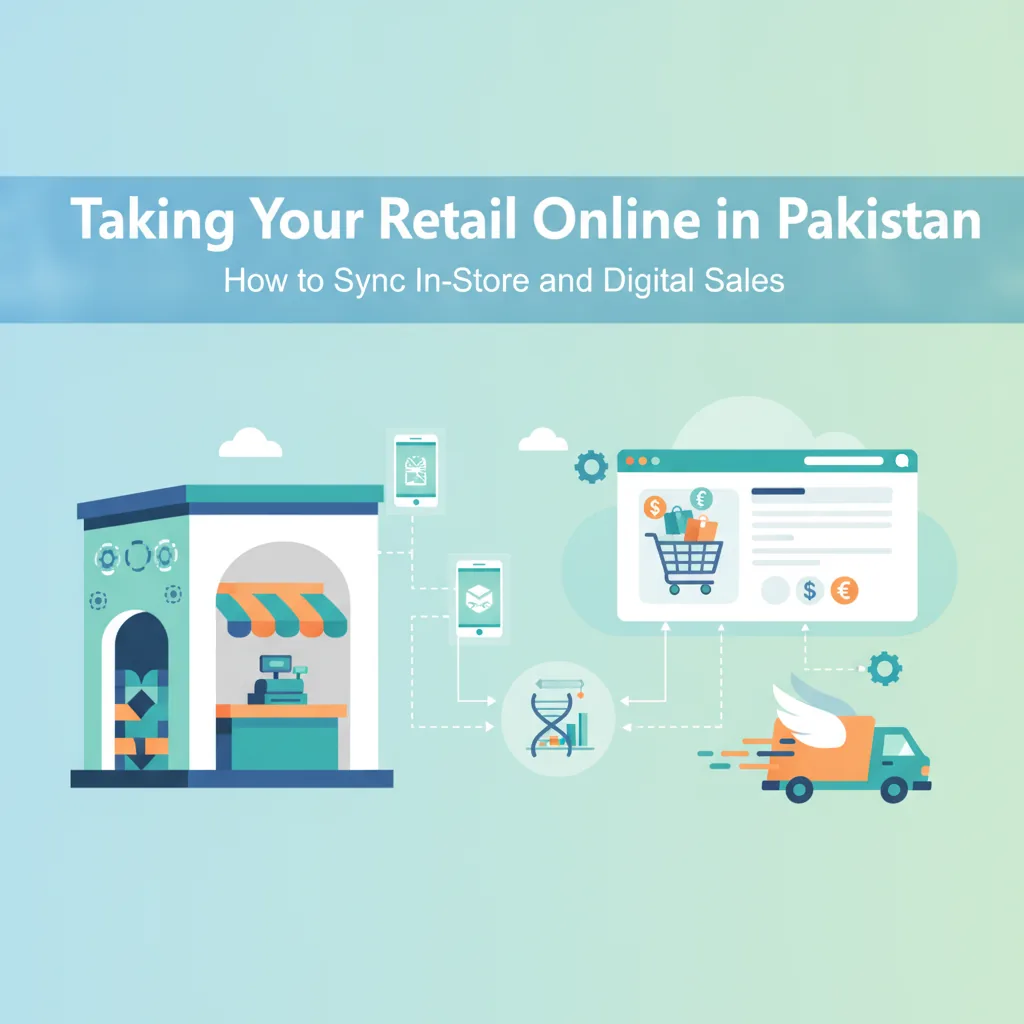
Taking Your Retail Shop Online in Pakistan: How to Sync In-Store and Digital Sales
Transitioning from a brick-and-mortar shop to an online store in Pakistan often leads to stockouts, double selling, and courier reconciliation headaches. This practical guide explains how to connect your physical counter with an online storefront, unify your inventory, and scale sales without operational chaos.
In this article
- The 4 Hidden Traps of Launching an Online Store
- The 5-Step Blueprint for Taking Your Retail Shop Online in Pakistan
- 1. Standardize Your Master SKU and Barcode Architecture
- 2. Define Your Fulfillment Strategy
- 3. Automate Bi-Directional Inventory Synchronization
- 4. Set Up a Streamlined Dispatch and Courier SOP
- 5. Unify Order Statuses and Return Management
- Checklist: Launching Your Shop’s Online Wing
- How CloudPOS Helps Retailers Expand Online
- Scale Your Retail Footprint with Confidence
If you run a retail shop in Tariq Road Karachi, Liberty Market Lahore, or Saddar Rawalpindi, your daily rhythm revolves around walk-in footfall, cash register rings, and shelf merchandising. But physical foot traffic has an undeniable geographic ceiling. There are only so many customers who will walk past your storefront on any given Tuesday. That is why taking your retail shop online in Pakistan has become the next step for growing store owners.
According to commercial market analysis by the International Trade Administration, Pakistan’s retail eCommerce market has climbed past $5 billion, driven by widespread mobile connectivity and accelerating digital transactions. For ambitious shop owners, taking your business online is no longer a speculative side project—it is the fastest way to expand from a local bazaar shop into a nationwide brand.
Yet, hundreds of Pakistani retailers stumble in their first six months online. The problem is rarely a lack of customer demand; it is operational disconnect. When your physical counter and your online store operate in separate silos, you inevitably face overselling, inventory inaccuracies, delayed dispatch, and courier reconciliation nightmares. Here is how to launch and scale an online wing for your brick-and-mortar store without turning your daily operations upside down.
The 4 Hidden Traps of Launching an Online Store
Most retailers start their digital journey by hiring a web developer to build a storefront, uploading product photos, and waiting for orders. Within weeks, real-world friction sets in:
- The Double-Selling Trap: You have one last medium embroidered stitched suit or a specific model of an imported blender left on your display rack. At 4:15 PM, a walk-in customer buys it at the register. At 4:22 PM, an online customer in Multan purchases the same SKU on your website. Your staff scrambles, calls the customer to apologize, and cancels the order, destroying customer trust before the relationship even starts.
- Catalogue and Pricing Friction: Updating prices, discount campaigns, and product variants across two disconnected systems burns hours of manual labor. When you change an in-store sale price for an upcoming Eid campaign, forgetting to update the website results in margin loss or angry shoppers demanding price matches.
- Cash-on-Delivery (COD) Cash Flow Gaps: In Pakistan, cash on delivery still accounts for the vast majority of eCommerce orders. When goods leave your shop shelf, they are physically gone, but courier partners typically take 5 to 14 business days to disburse remittances. Without clear ledger tracking, your accounts misreport revenue and stock valuations.
- Fragmented Customer Histories: When a loyal in-store shopper visits your online portal, their order history, preferences, and purchase frequency should ideally follow them. Disconnected systems treat VIP counter clients like complete strangers online.
The 5-Step Blueprint for Taking Your Retail Shop Online in Pakistan
Scaling beyond your physical storefront requires structuring your backend workflows before driving heavy online marketing traffic. Follow these five core steps to bridge the counter-to-cart divide.
1. Standardize Your Master SKU and Barcode Architecture
You cannot sync what you cannot accurately identify. Every single product in your shop must possess a unique Stock Keeping Unit (SKU) code and a standard barcode (such as EAN-13 or custom numerical barcodes). If an item has multiple sizes, colors, or flavors, each individual variant requires its own distinct barcode. When physical and digital channels refer to identical SKU numbers, stock deductions happen automatically without human guesswork.
2. Define Your Fulfillment Strategy
Pakistani retailers generally adopt one of two stock models when expanding online:
- Shared In-Store Inventory (Shelf Fulfillment): Web orders are picked directly from the retail floor or the store’s attached backroom. This minimizes upfront capital because you do not buy duplicate inventory. However, it demands instantaneous stock deduction so cashiers do not sell an item already reserved for an online parcel.
- Dedicated Online Reserve (Godown Allocation): If you run a larger operation or wholesale business, you can designate a percentage of stock specifically for digital sales in a separate godown or storage rack. This guarantees physical walk-ins cannot deplete eCommerce stock during seasonal promotions.
3. Automate Bi-Directional Inventory Synchronization
Never rely on staff to manually adjust stock figures on a web dashboard at the end of every business day. During peak shopping hours, manual updates are forgotten, leading to immediate stock discrepancies. Your point of sale software and your online platform must communicate automatically: when a barcode is scanned at the cash register, online inventory drops instantly. When an online order is placed, that quantity is marked as reserved on the central register.
4. Set Up a Streamlined Dispatch and Courier SOP
Online retail success hinges on quick fulfillment. Designate a dedicated packing corner inside your shop equipped with a thermal label printer, poly mailer bags, bubble wrap, and a dispatch log. Integrate with courier services (such as TCS, Leopards, Trax, or Call Courier) so that shipping labels, booking airway bills (AWBs), and tracking numbers are generated directly from your order management screen rather than through manual courier portal entries.
5. Unify Order Statuses and Return Management
Returns and exchanges are a reality of retail in Pakistan, particularly in fashion and footwear where Return to Origin (RTO) rates can reach 15% to 25%. Establish clear Standard Operating Procedures (SOPs): when a customer rejects a COD parcel at the doorstep, how does that parcel return to your physical shelf? It must be inspected, scanned back into the POS inventory as returned stock, and removed from the active courier ledger so your books stay balanced.
Checklist: Launching Your Shop’s Online Wing
Save and review this operational checklist before announcing your online store to the public:
- Data Readiness:
- Every product variant has a clear title, high-resolution photo, selling price, and unique barcode.
- Cost prices and supplier records are documented to track gross margins accurately.
- System Integration:
- Central inventory ledger configured to sync across physical registers and the web store.
- Low-stock alert thresholds configured to prevent overselling scarce items.
- Offline billing capability verified so in-store checkout never halts during an internet disruption.
- Payment and Logistics:
- Courier corporate merchant accounts opened with agreed COD remittance cycles.
- Digital payment gateways or wallet transfers (such as Raast QR, debit cards, or mobile wallets) integrated alongside COD options.
- In-Store Operations:
- Packaging workstation setup with tape, thermal shipping labels, and tamper-evident flyers.
- Staff trained on order packing, reservation workflows, and return handling.
How CloudPOS Helps Retailers Expand Online
Transitioning from a standalone counter to a multi-channel business requires software built for the realities of Pakistani retail. CloudPOS combines a cloud-based point of sale with an AI-powered ERP platform to unite your physical counter and digital sales under one unified roof.
Here is how CloudPOS supports your retail growth:
- Direct eCommerce Integration: CloudPOS connects your in-store point of sale with leading eCommerce platforms. When a product sells at your cash counter, web stock decreases in real time. When an online order lands, it appears in your CloudPOS order dashboard, eliminating double entry.
- Reliable Hybrid Offline Billing: Internet downtime should never paralyze your shop. CloudPOS continues high-speed barcode billing offline during load shedding or connectivity drops, and syncs all sales to the cloud automatically once internet returns.
- Real-Time Multi-Location Inventory: Whether fulfilling orders from a single shop counter, a backroom godown, or multiple branch outlets across cities, manage all inventory and transfers from a single central account with smart low-stock alerts.
- Courier and Digital Payment Connectivity: CloudPOS integrates with courier services and digital payment systems, enabling faster parcel generation and seamless financial reconciliation.
- Unified Customer Management: Maintain a single customer profile that records past purchases, preferences, and payment habits across both walk-ins and digital touchpoints.
- Mobile Management Apps: Check live daily counter sales, monitor pending web shipments, and track inventory levels from your smartphone wherever you are.
Scale Your Retail Footprint with Confidence
Taking your retail shop online is one of the most profitable strategic moves a Pakistani business owner can make. It unlocks revenue from customers hundreds of kilometers away without the heavy overhead of leasing new commercial real estate. But an online store is only as reliable as the inventory and checkout systems powering it behind the scenes.
By establishing clear barcode architecture, standardizing dispatch SOPs, and running on a unified cloud platform, you eliminate overselling and build a resilient retail business ready for long-term growth.
Ready to connect your physical counter to an online storefront? Contact our Gujrat team at +92 309 308 9999 or book a free CloudPOS demo to see how seamless omnichannel retail can be.